Microdrama vs Reels vs OTT: Who Really Owns the Viewer?
The next big thing in video isn’t shorter; it’s stickier.
Author: Murali Manohar
Date: 18 September 2026
For years, the battle for video attention seemed straightforward. Reels owned the scroll. OTT owned the screen. Now there is a third contender- microdrama.
Built around short, episodic stories designed primarily for mobile viewing, microdramas sit somewhere between the instant discovery of Reels and the narrative depth of OTT. And in India, the format is moving fast. Microdrama audiences grew 50% in 2026, making it one of the fastest-growing content formats tracked by Ormax.
But the more interesting question isn’t whether microdramas are growing. It’s who actually owns the viewer.
Reels Own Discovery. OTT Owns Depth. Microdramas Are Building the Habit.
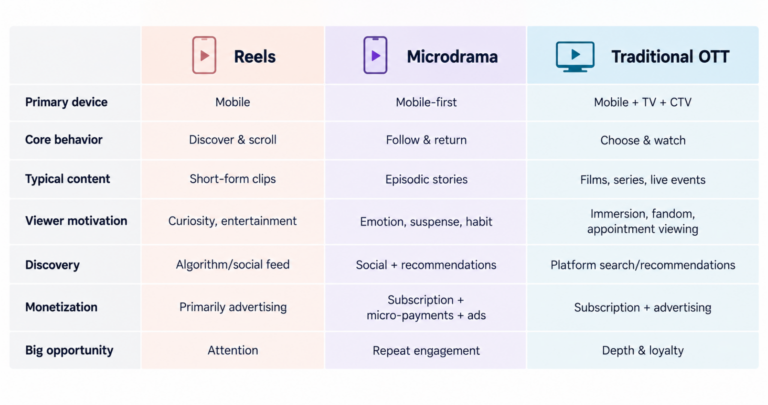
The three formats compete for attention, but they are built around different viewing behaviors.
Reels are built for discovery. You open a social feed without necessarily knowing what you want to watch. The algorithm decides. Swipe, watch, swipe again.
OTT is built around intent. You open a streaming service because you have already decided to watch something, a film, a series, or a live sports event.
Microdrama sits somewhere between the two.
It takes the algorithmic discovery and mobile-first behavior of short-form video and combines it with something Reels generally lacks: a continuing story that gives viewers a reason to come back.
Meta and Ormax found that 89% of Indian microdrama viewers discover the format through social feeds and recommendations. That’s the important shift.
Microdrama doesn’t necessarily replace the feed. It turns the feed into a gateway to a story.
Three Formats, Three Different Jobs
The distinction matters because attention is not the same as engagement, and engagement is not the same as monetization.
A reel may win a viewer for seconds
A microdrama can give that viewer a reason to return tomorrow
An OTT series can keep that viewer for several hours
The platforms that understand how these behaviors connect could have an advantage as video consumption becomes increasingly fragmented.
Microdrama Is Not Just Shorter OTT
It would be easy to describe microdrama as television compressed into one- or two-minute episodes. That misses what makes the format different.
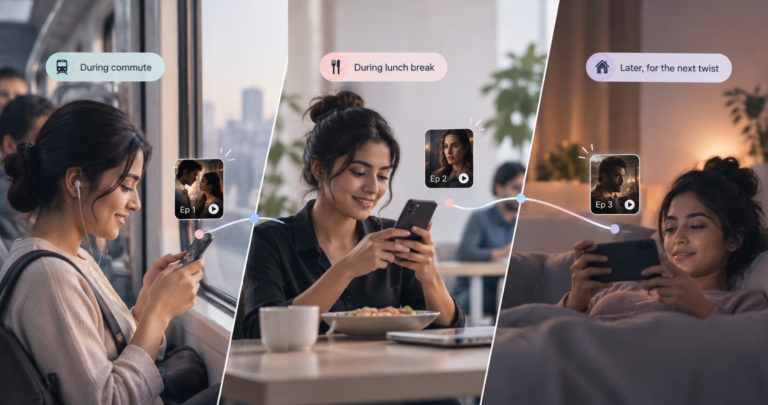
Microdramas are being designed around short attention windows, vertical viewing, cliffhangers, and algorithmic discovery. A viewer can watch an episode during a commute, continue the story during lunch, and return later for the next twist.
That creates a powerful combination: Short-form consumption + long-form emotional continuity. And audiences are responding.
Ormax reports that microdramas were the fastest-growing major content format in India in 2026, ahead of K-dramas and anime.
The category is also becoming increasingly competitive. Kuku TV, Quick TV, Story TV, DramaBox and ReelShort are among the names shaping India’s microdrama ecosystem. Established entertainment companies are moving in as well.
Sun NXT is a notable example, bringing short-form dramas and micro-series into its existing streaming ecosystem across South Indian languages. This points to an important shift: microdrama is no longer limited to standalone short-drama apps. Traditional OTT platforms are beginning to explore how the format can fit into their broader content strategies.
The Real Opportunity: Monetizing the In-Between Viewer
Microdrama’s biggest opportunity may not be subscriptions alone. It may be the enormous audience that sits between “I want to watch for free” and “I am willing to subscribe.” Redseer estimates that around 40 million Indians have paid for microdrama at least once, while the broader addressable audience is estimated at 250–280 million.
That leaves considerable room for monetization. And advertising could be an important part of the equation.
Redseer projects India’s microdrama market could grow from approximately ₹2,300 crore in FY26 to ₹23,500–25,500 crore by FY32. It also projects AVOD daily active users could reach 140–150 million by FY32, compared with roughly 20 million today.
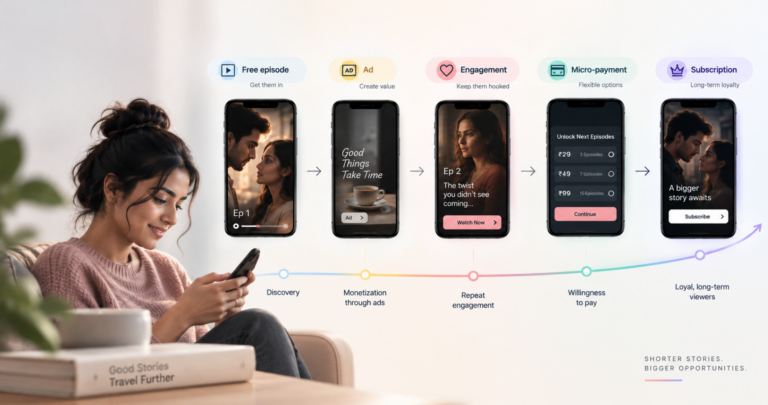
The emerging model could therefore look less like: “Free – Subscribe” and more like: “Free episode – Ad – Engagement – Micro-payment – Subscription.” That flexibility could become one of microdrama’s biggest strengths.
What Happens When AI Enters the Picture?
The next stage could be even more interesting.
AI can reduce the time and effort required to create, localize, and distribute short-form episodic content. That could mean faster scripting, dubbing, subtitling, versioning, metadata creation, and promotional content.
Instead of producing a small number of expensive shows and waiting months to see what works, platforms could increasingly test more stories, learn from audience behaviour, and scale the formats that resonate.
That changes the economics of content. The opportunity is no longer simply content production at scale. It could become content experimentation at scale. For India, where audiences are spread across multiple languages and viewing contexts, localization could be just as important as production.
So, Who Really Owns the Viewer?
Maybe nobody owns the entire journey anymore.
Reels own discovery.
OTT owns depth.
Microdrama is trying to own repeat behavior.
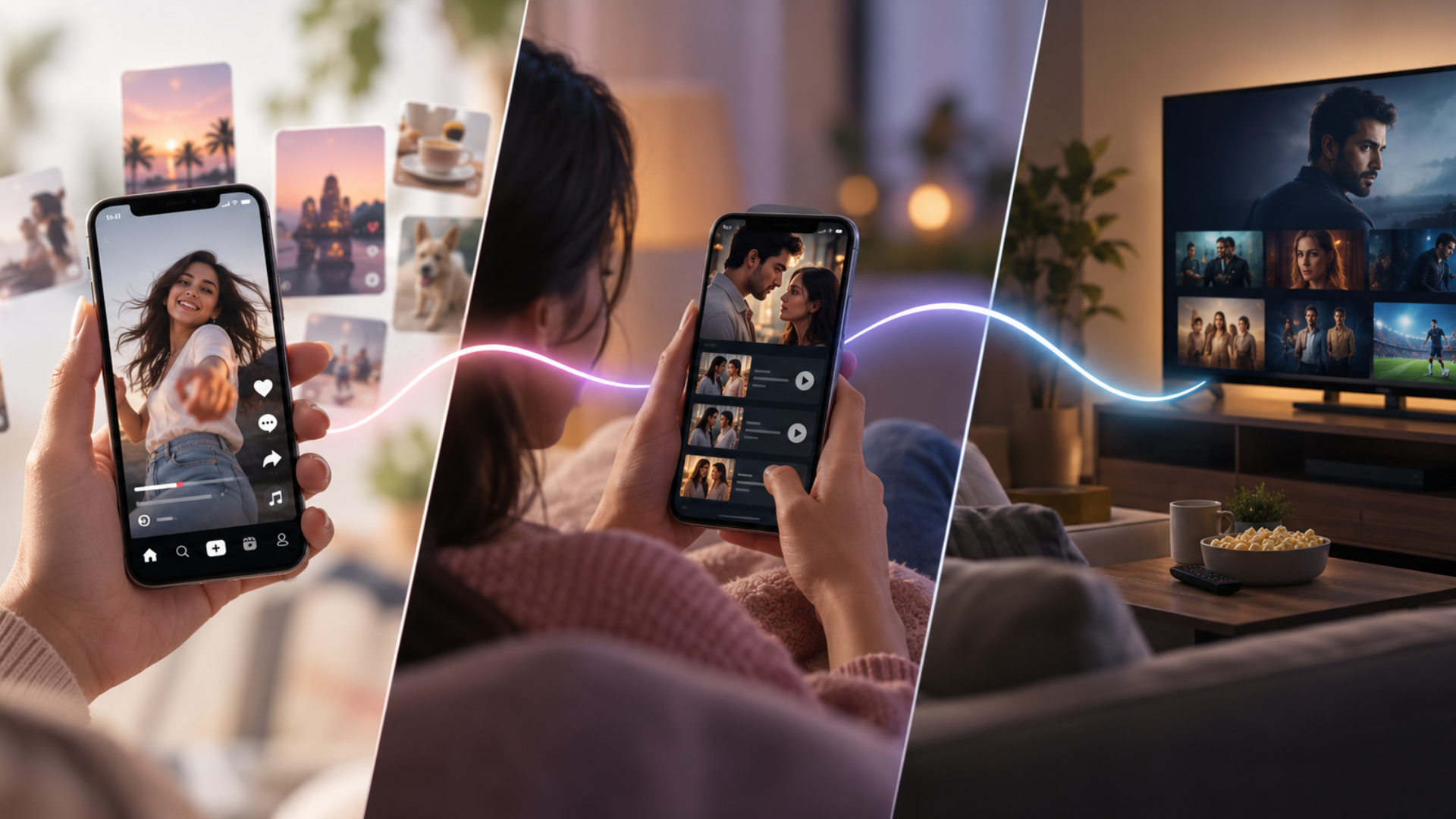
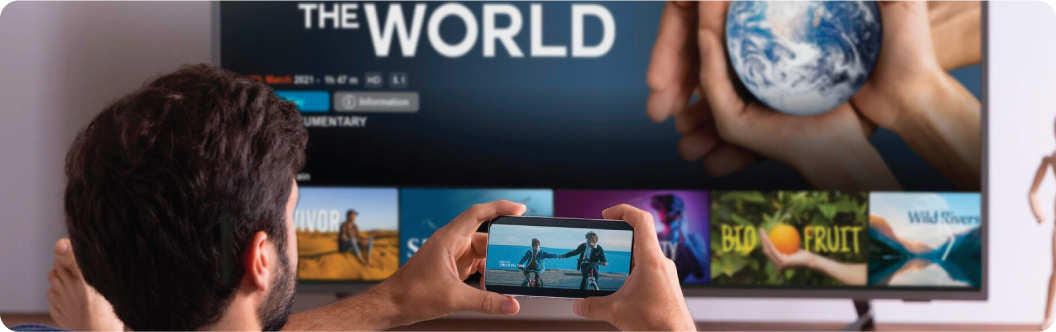
And the boundaries are already starting to blur. A viewer can discover a character through a Reel, follow the story through a microdrama app, watch a longer adaptation on OTT, and eventually move to a connected TV. The future of video may therefore be less about choosing between formats and more about connecting them intelligently.
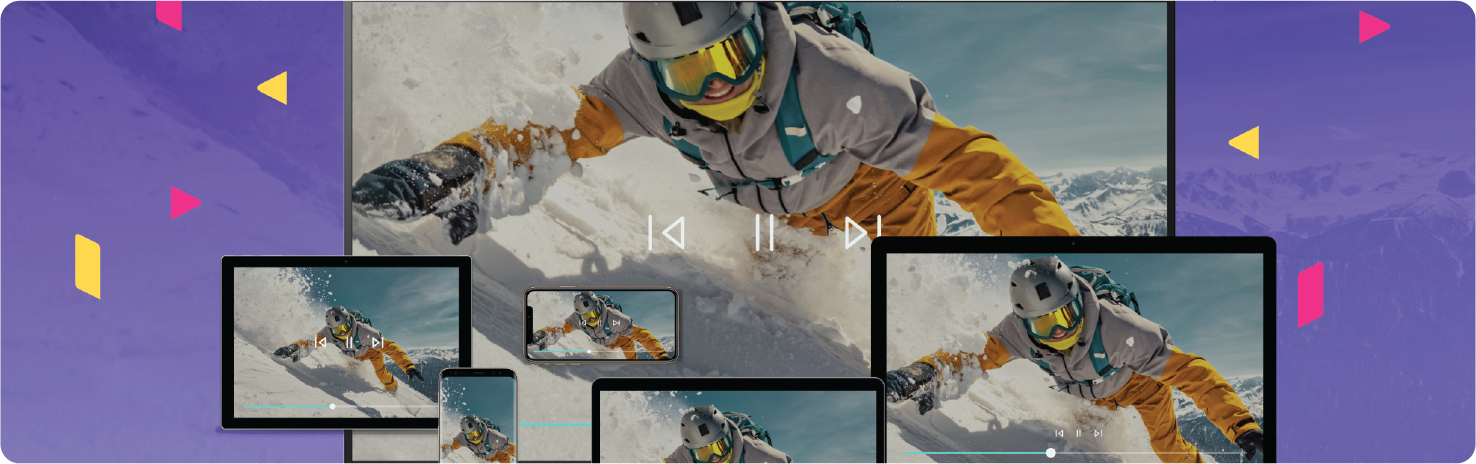
For video platforms, that means technology needs to support short-form and long-form content, multiple devices, rapid content cycles, localization, personalization, monetization, and reliable playback, without forcing every new format into the same old OTT architecture.
Building the Technology Behind the Next Generation of Video
This is where an end-to-end video platform becomes important.
LogixStream brings the core components of an OTT and video ecosystem together, from content management and distribution to multi-platform experiences, AI-powered enrichment, engagement, and monetization.
For platforms exploring microdrama, that means the opportunity isn’t simply to add short episodes to an existing app. It is to build an experience where content can be discovered, personalized, localized, monetized, and delivered seamlessly across screens.
Because the next battle for the viewer may not be Reels vs. microdrama vs. OTT. It may be about who can connect all three.
Exploring microdrama or the next evolution of OTT?
Write to us at marketing@logituit.com to discuss how LogixStream can help you build and scale your video experience.
To provide the best experiences, logituit.com use technologies like cookies to store and/or access device information. Consenting to these technologies will allow us to process data such as browsing behaviour or unique IDs on this site. Not consenting or withdrawing consent, may adversely affect certain features and functions.