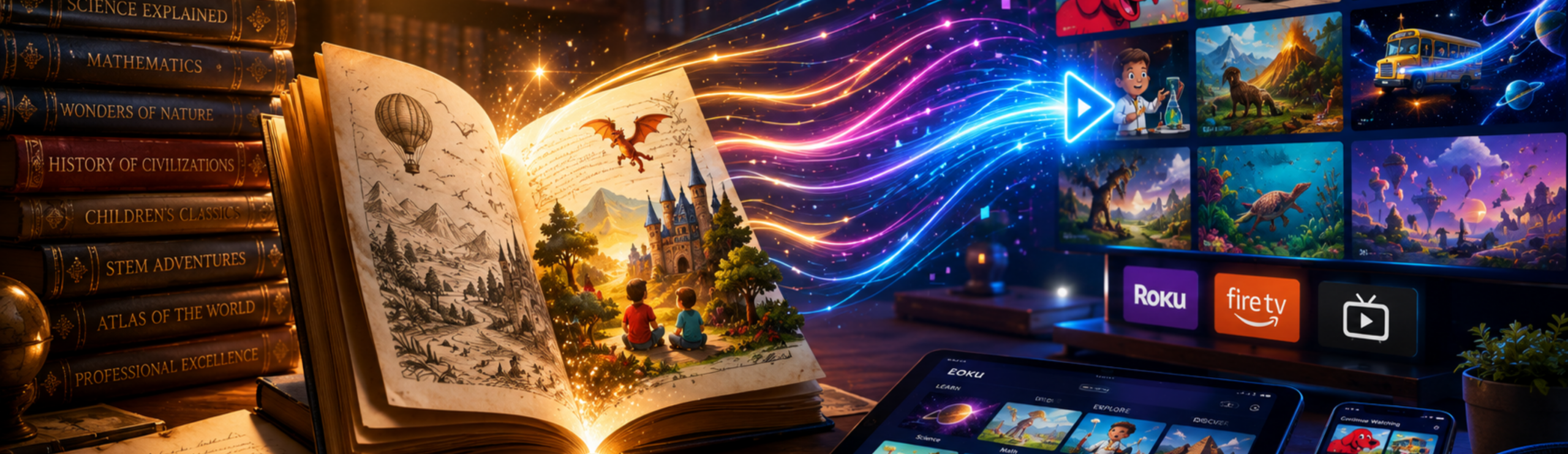
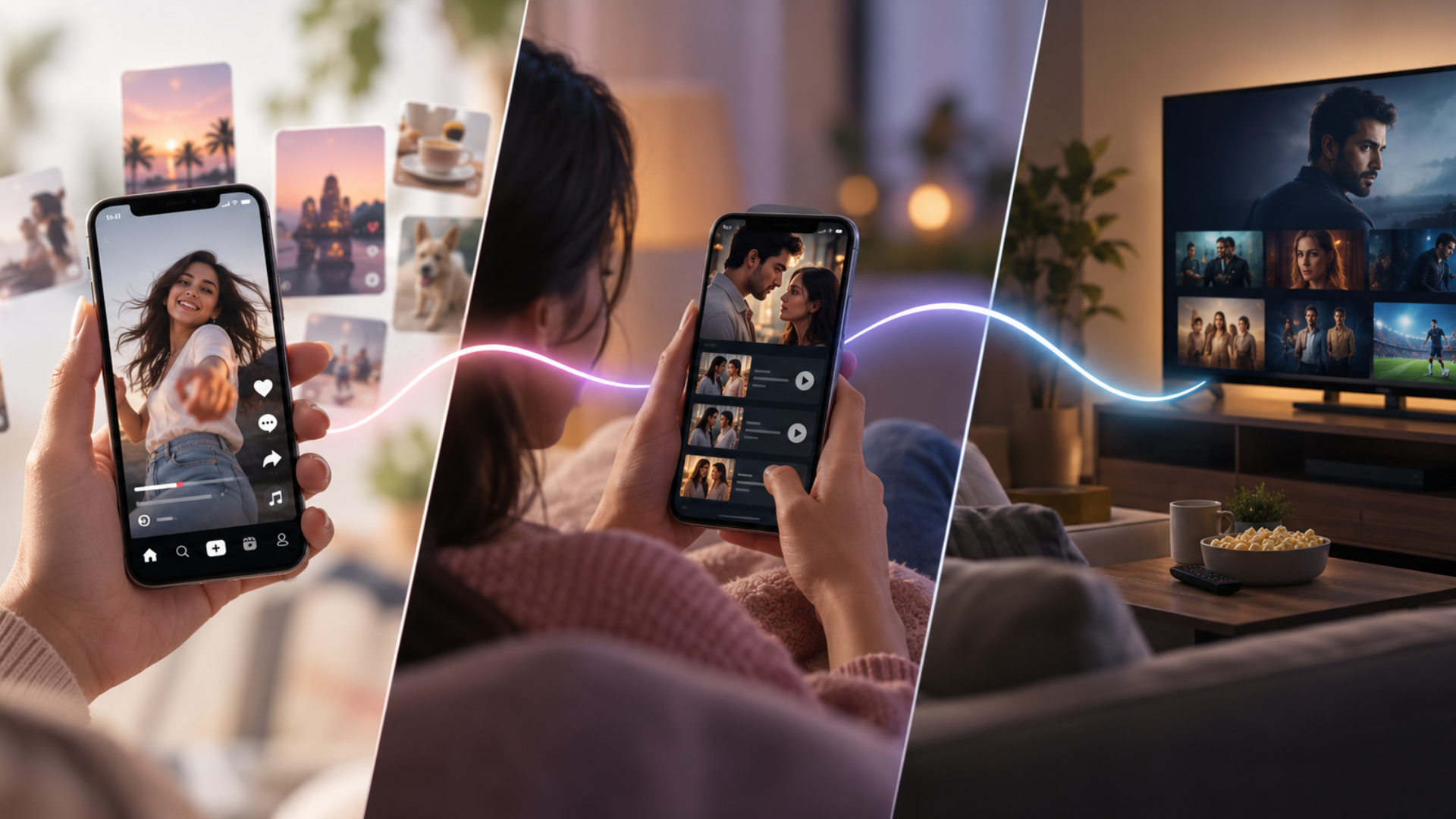
In September 2025, Scholastic did something interesting. The 105-year-old children’s publisher launched its own free streaming app on Roku and Amazon Fire TV, loading it with 400 hours of programming built from titles most people assumed had retired years ago — Clifford the Big Red Dog, The Magic School Bus, Goosebumps, Anamorphs.
None of that content was new. All of it was Scholastic’s backlist, reformatted for screens and placed where a new generation of families actually watches.
It’s a useful question for every publisher to sit with: why did Scholastic do this, and why now?
The Curve Publishers Don’t Talk About
Every publisher understands the economics of a new title: advance, production, print run, marketing, sales curve peaking in year one, tailing off by year three.
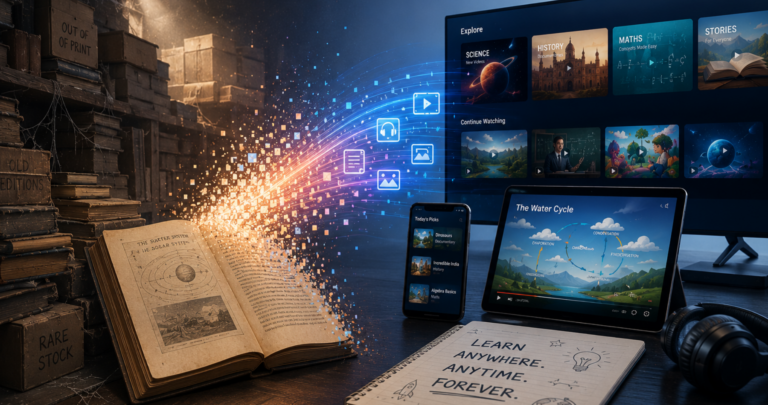
What gets discussed far less is the flat line after that. A title that sold well in 2018 sits in a warehouse or a digital catalogue — occasionally surfacing in a sale, a bundle, a rare institutional order. It is not being actively marketed. It is almost certainly not being consumed by a digital-native learner who has never heard of it.
The content itself has not aged. The knowledge inside a well-written STEM textbook, a children illustrated classic, or a professional reference work does not expire. But the format in which it exists has become invisible to readers who now consume primarily through screens, primarily through video, and primarily on demand.
This is not a content problem. It is a distribution and format problem. And for the first time in publishing history, it is entirely solvable.
What Is Actually Sitting in Your Catalogue?
A mid-sized Indian education publisher with fifteen years of operation typically holds 500 to 2,000 active titles. A larger trade or professional publisher holds considerably more. Some of India’s oldest houses hold catalogues that run to tens of thousands. Every one of those titles represents a real investment — editorial, illustration, rights acquisition, fact-checking, curriculum alignment. That cost was incurred once. The amortisation period was treated as three to five years. But the content asset has an indefinite shelf life.
The question worth asking is straightforward: if you could convert that content into a format today’s audiences actually consume — and place it where they actually spend their time — what would the revenue look like?
Most publishers have never seriously modelled this. Until recently, the economics made it pointless.
Why It Wasn’t Worth Doing — Until Now
Converting a textbook or an illustrated series into video was, until very recently, expensive and slow. Professional production for educational video ran between ₹3 lakh and ₹40 lakh per title depending on complexity. For a catalogue of 500 titles, the arithmetic was impossible.
Distribution was the second wall. Building your own streaming platform was a multi-crore infrastructure bet. Licensing to OTT platforms needed relationships, volume, and formats most publishers weren’t set up to deliver. YouTube was accessible in theory and punishing in practice.
So, the backlist stayed buried. And the industry collectively agreed, without quite saying so, that video was someone else’s business.
What Changed — And Who Is Already Moving
Two things shifted simultaneously, and both sides of the equation turned viable at once.
The production cost curve has collapsed.
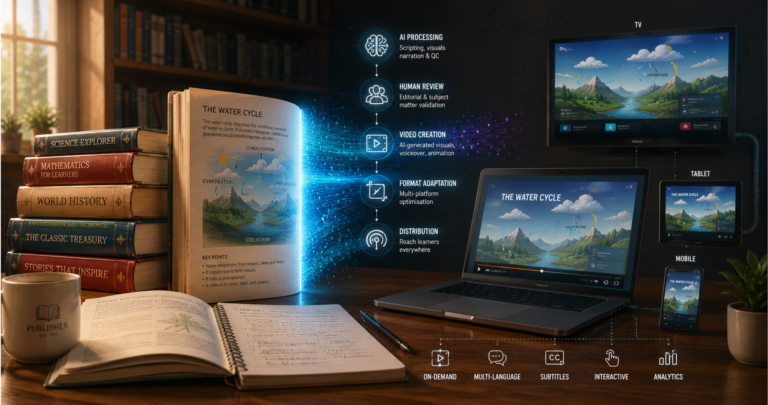
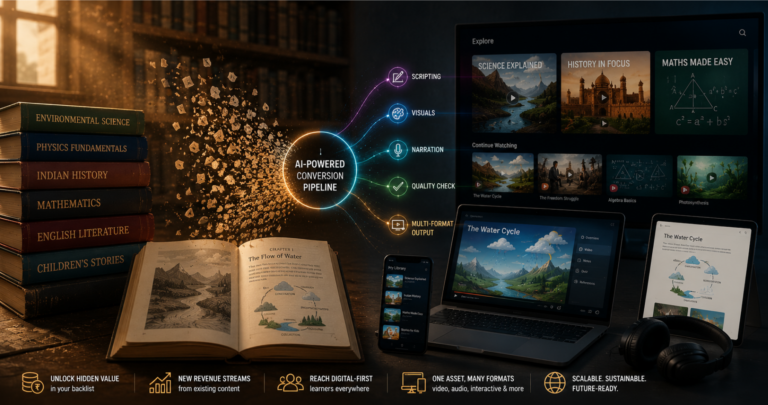
Generative AI has brought the cost of converting a well-structured text title into broadcast-quality video down by roughly 90%. Not through a loss of quality — through a fundamental restructuring of the pipeline. AI handles scripting, visual generation, narration, and initial QC. Human editorial review, which remains non-negotiable for educational content, is applied at the output stage rather than at every step.
A title that cost ₹15 lakh to produce two years ago now comes in at ₹1–2 lakh. A catalogue of 200 titles — once a ₹30 crore project — becomes a manageable phased investment. Pearson, the world’s largest education publisher, reported in April 2024 that it was doubling its video content development versus the prior year, with a growing slate of on-demand AI video courses and live virtual training drawn directly from its existing author catalogue.
The distribution landscape has opened up.
Three real-world moves tell the story of what publishers are now doing with their backlists.
Scholastic + 9 Story Media (September 2025). Launched a free ad-supported streaming app on Roku and Amazon Fire TV, opening with 400 hours of programming from its existing catalogue — Clifford, The Magic School Bus, Goosebumps — with partnerships already in place with Moonbug, LEGO, and Chuck E Cheese. 9 Story’s digital arm now manages 130 brands across 17 languages on YouTube alone.
Pearson’s digital-first pivot. By 2022, over 70% of Pearson’s revenue came from digital products. Video now sits at the centre of its growth strategy — Pearson publicly stated in 2024 that AI study tools embedded in its higher education courseware were driving “double-digit revenue growth.” The content is the same author catalogue. The format and delivery have changed entirely.
The Nordic audio streaming market. Storytel, BookBeat, and Nextory — none of them publishers themselves — have built the growth engine of the entire Swedish book market by restructuring backlists into audio. By 2020, subscription streaming accounted for 57% of volumes consumed in Sweden. Bonnier, the Swedish publishing group, built BookBeat itself rather than let the opportunity pass.
In each case, the underlying content was already owned. What changed was the publisher’s willingness to treat the backlist as a format-agnostic asset rather than a stock of printed books.
Six Revenue Streams That Open Up
When a publisher converts backlist content into multilingual video and places it across the right channels, several streams become available simultaneously — most for the first time:
Subscription licensing. EdTech platforms in K–12 and higher education actively license premium catalogues for annual fees, with rights remaining with the publisher.
Video advertising. Educational content commands among the highest CPMs in digital — typically ₹600–₹2,000 per thousand views. A catalogue generating 2–3 million monthly views generates meaningful AVOD revenue with no ongoing production cost.
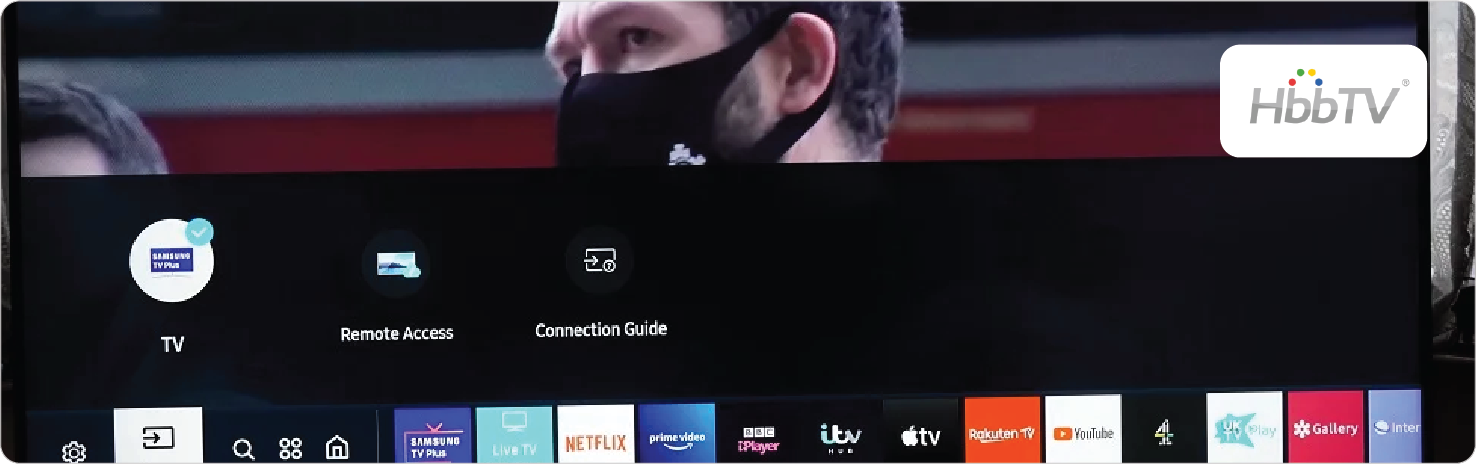
FAST channels. A branded channel on Samsung TV Plus, Roku, or Amazon Fire TV reaches millions across India and the diaspora, funded by advertising with zero subscriber acquisition cost. This is exactly what Scholastic launched last September.
OTT and institutional licensing. Platform deals, school district bundles, corporate learning licences — larger, structured, longer-cycle agreements with significant scale.
Corporate L&D. STEM and professional content packaged for LinkedIn Learning, Udemy Business, Coursera for Business. A global L&D market worth hundreds of billions, actively buying curated content.
Multilingual expansion. AI dubbing at scale in Hindi, Tamil, Bangla, Telugu, Arabic — markets that English-only content simply cannot reach. The Indian diaspora alone is a substantial, underserved audience.
None of these streams requires a new author, a new idea, or new research. The content is already written. The IP is already owned.
Why the Next Eighteen Months Matter
Scholastic did not move first because Scholastic is a streaming pioneer. It moved because the window for category presence is finite.
Publishers who commit in the next twelve to eighteen months will build distribution relationships, FAST channel inventory, and platform partnerships before the category becomes crowded. Those who wait will negotiate from weaker positions — competing for the same shelf space, pressing down on the same licensing rates, claiming smaller slices of FAST inventory.
Your catalogue is unique. The editorial judgment built over fifteen or twenty years cannot be synthesised quickly by a competitor or a language model. But that advantage is only real if you act on it.
A content library that stays in a warehouse — physical or digital — is not a competitive asset. It’s an accounting entry.
Where to Start
The practical question is always: where do we begin? The catalogue is large, the technology unfamiliar, the distribution relationships non-existent.
The answer is consistent across every successful case I have seen start small, prove the unit economics, then scale.
A five-title Proof of Concept — across a mix of your strongest categories, tested in two or three languages, placed on two or three distribution channels — produces real data. Real view counts, real engagement metrics, real revenue signals. It replaces theory with a spreadsheet you can take to your board.
The infrastructure exists. The economics work. The distribution channels are ready.
The only decision left is whether to keep treating your backlist as an archive — or to treat it as what it actually is: an asset that has been underperforming for years, and that is ready, right now, to be put to work.
About the Author
Krishna Tewari is Chief Growth Officer (Media Technology Division) at Logituit and writes on content, technology, and the business of knowledge. He advises organisations across media, publishing, and technology on growth strategy and digital transformation.
To provide the best experiences, logituit.com use technologies like cookies to store and/or access device information. Consenting to these technologies will allow us to process data such as browsing behaviour or unique IDs on this site. Not consenting or withdrawing consent, may adversely affect certain features and functions.