We Stopped Hiring for Code, started Orchestrating Intelligence.
Rethinking how modern software gets built.
Author: Atharva Kawale
Date: 1 April 2026
There is a version of this industry where “AI-assisted development” means a developer opens a chat window, asks for a function, pastes it in, and calls it a day.
That version already feels dated.
What our team has been quietly building over the past several months is something categorically different. Not a tool that helps engineers write code faster. A workflow that takes an entire production application, the kind engineers spent years building, and migrates it to a completely different platform, end to end, autonomously.
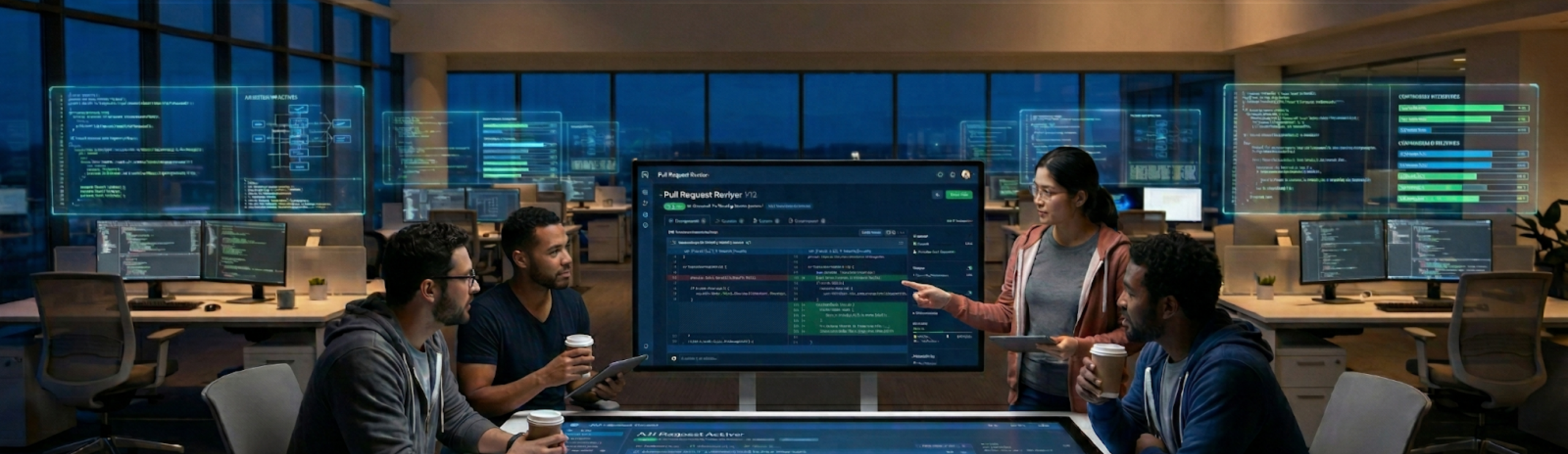
We did not build a smarter autocomplete. We built an engineering team that never sleeps.
The Problem Nobody Wants to Admit
Here is the uncomfortable truth about cross-platform development in 2026.
Every organization with a mature mobile application knows this scenario. The product works. The users love it. Then leadership looks at the platform landscape, streaming devices, new operating systems, cross-platform frameworks, and decides the same experience needs to exist in three new places simultaneously. What happens next is completely predictable.
Roadmaps stretch. Timelines double. Teams get split across codebases. Institutional knowledge about the original application slowly dilutes as each platform team builds its own parallel understanding of the product.
The conventional answer to this problem is to hire more engineers. Our answer was to question the premise entirely.
What “Agentic” Actually Has to Mean to Be Useful
The word “agentic” has been abused so thoroughly in the past two years that it has almost lost meaning. Every chatbot wrapper, every automated email drafter, every “AI-powered” feature got the label slapped onto it.
Here is what we mean when we use the word.
A genuine agentic workflow does not respond to prompts. It understands goals. It decomposes those goals into ordered steps. It executes those steps across real tools and systems. And critically, it recovers from failure without asking a human what to do next.
The moment you internalize that definition, you realize most things being called “agentic” in 2025 were not. They were sophisticated autocomplete with an API call stitched on. Useful, sure. But not the same thing.
What we built crosses that line. And building across that line is genuinely hard in ways that have nothing to do with model capability.
What We Are Actually Running
Our workflows operate across three distinct problem domains right now.
Cross-platform application migration. We take production Android codebases and generate equivalent applications for multiple target platforms simultaneously. The workflow ingests the source application at a structural level, builds a deep knowledge base of its architecture, conventions, API surface, and UI patterns, then generates platform-native code for each target. The human engineer reviews the output and tunes it. They do not write it from scratch.
Automated test case generation. We feed structured requirement documents, the kind that already exist in every QA team’s backlog, directly into an agentic workflow that generates executable test scenarios. Edge cases, boundary conditions, and failure paths are all derived systematically from the requirements, without a human sitting down to think through scenarios manually.
The QA engineer’s job becomes review and execution, not authorship. Both of these are running against real codebases and real requirements documents. Not demos. Not synthetic inputs. Production-grade work.
The Architecture Lesson That Changed How We Think
Here is what we learned that no amount of reading about agents will teach you.
Single-agent designs break. Not sometimes. Always, eventually, at scale, under complexity.
The instinct when building an agentic system is to make one very capable agent and give it everything: all the context, all the tools, all the instructions. This feels elegant. It is a trap. The more you load into a single context, the more the model loses coherence. It hallucinates parameters deep into a task. It forgets constraints it was given twenty minutes ago. It loops.
The answer is specialization and coordination. Multiple focused agents, each owning a narrow domain with clear inputs and outputs, orchestrated by a coordinator that holds global state. Think of how a senior engineering team actually works: a systems architect does not also write every line of UI code. Different people own different concerns. The coordinator, the tech lead, ensures the pieces fit.
The same logic applies to agents. The architectural shift from “one powerful agent” to “many specialized agents with a coordinator” is the single most important design decision in building workflows that actually scale.
Where the Real Difficulty Lives
Let us be honest about where this work is hard. And it is not where most people assume.
The models are not the bottleneck. Frontier model capability has crossed the threshold needed for this class of work. The raw reasoning is there.
The hard part is operational discipline. Specifically:
Cost control is an active engineering concern, not a finance problem. An agentic workflow running complex multi-step orchestration can consume inference budget at rates that are completely invisible until they hit your billing dashboard. We treat token spend as a first-class engineering metric, the same way we track latency and error rates.
Validation gates matter more than generation quality. The agent that writes code is less important than the system that checks whether that code is correct before it proceeds. Deterministic constraint checks, semantic validation, build verification, these are not nice-to-haves. They are the difference between a workflow that produces usable output and one that produces plausible-looking nonsense at scale.
Human review is a design choice, not a fallback. The workflows that fail are the ones that try to remove the human entirely. The workflows that succeed define exactly where human judgment enters, and protect that moment carefully. We do not try to automate human review. We try to make human review as focused and high-value as possible by handling everything else autonomously.
The Shift We Are Watching in Real Time
Something is changing in how engineering work is actually structured.
The historical model is: a developer is assigned a task, writes code, submits it for review. The developer is the primary creator.
The model we are moving toward: a developer defines the goal and the constraints, an agentic workflow produces the artifact, and the developer’s job is to evaluate, refine, and direct the next iteration. The developer is the orchestrator.
This is not a small change. It rewrites the skill profile of what makes a great engineer. The ability to write code quickly matters less. The ability to define precise requirements, recognize quality in generated output, and course-correct a workflow that is drifting, these matter more.
The engineers thriving in this transition are not the ones resisting it. They are the ones who internalized the new role early and started building the judgment to exercise it well.
What Is Still Unsolved
We are not going to pretend we have this figured out entirely. There are open problems we are actively working through.
Hallucination in platform-specific knowledge is the most persistent issue. When a workflow encounters a runtime behavior or SDK quirk it does not have sufficient training context for, it reasons from analogies. Sometimes those analogies are correct. Sometimes they produce code that compiles but behaves wrong. Better validation catches this. Better knowledge bases reduce it. Neither eliminates it entirely yet.
Scaling to very large codebases requires architectural work that goes beyond current context limits. The solution is conceptually clear, decompose the codebase into sub-graphs, process them in parallel, merge with conflict resolution, but the implementation is non-trivial. We are building toward it.
The long-term target is a hosted pipeline: submit an application, receive a migration. That turns an internal capability into a product. We are not there yet. But the path is visible.
The Question Worth Sitting With
The industry conversation about agentic AI in 2026 is still mostly about capability. What can models do? How good is the reasoning? Which benchmark did the new release top?
These are the wrong questions for engineering teams right now.
The right questions are operational. Do you have validation gates that catch hallucinations before they hit your codebase? Do you have cost controls that prevent a logic loop from running up a thousand-dollar inference bill over a weekend? Do you have clear human review touchpoints that keep a domain expert in the loop without making them a bottleneck?
We have been quietly building the answers to those questions. The capability was never really the hard part.
The discipline to operationalize it is.
About Author
Atharva Kawale
Atharva is a dynamic Software Engineer with 3 years of experience at the intersection of Python development, DevOps, and AI/ML. Passionate about solving real-world problems through code, he’s increasingly focused on data analytics, ML pipelines, and intelligent automation.
A dedicated AI enthusiast, Atharva actively explores new models, frameworks, and workflows while staying on top of the latest trends through tech blogs and open-source communities.
To provide the best experiences, logituit.com use technologies like cookies to store and/or access device information. Consenting to these technologies will allow us to process data such as browsing behaviour or unique IDs on this site. Not consenting or withdrawing consent, may adversely affect certain features and functions.