BLOG
Author: Utkarsh Singhal
Date: 24 March 2026
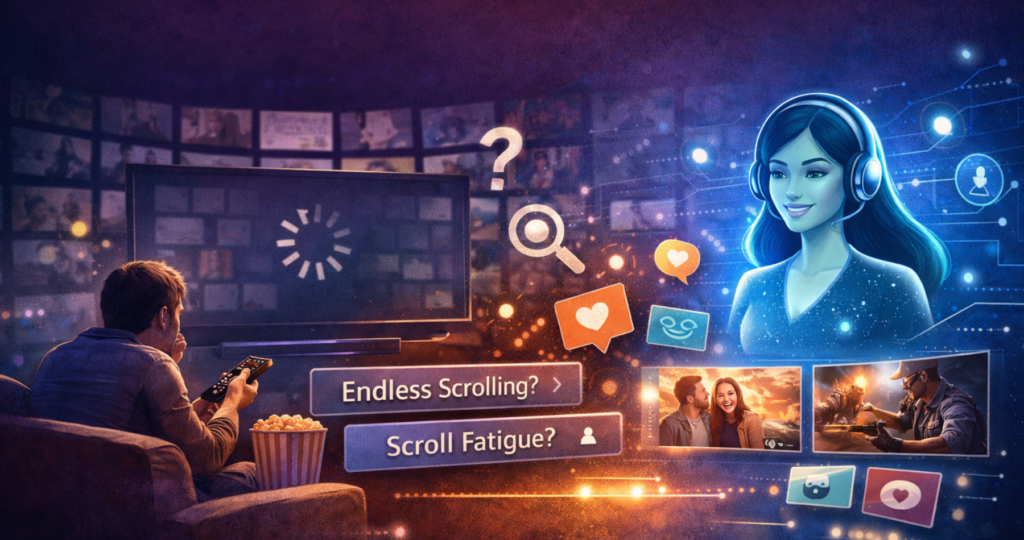
Picture this. It’s Friday evening. You open your favorite streaming app, stare at a wall of thumbnails, and scroll for ten minutes. Nothing clicks. You end up rewatching something you’ve already seen, or worse, you close the app entirely.
Sound familiar? You’re not alone.
This experience, scroll fatigue, is one of the most quietly damaging problems in OTT today. Platforms invest billions in content libraries, yet discovery still feels like a badly organized library with no librarian. Conversational AI is that librarian. And it just showed up.
The global OTT platform market has been on a sharp growth trajectory, and with that scale comes a paradox: the more content platforms add, the harder it is to find something worth watching.
Recommendation engines help, but they have a fundamental blind spot. They predict what you might like based on what you’ve watched before. They don’t understand what you want right now, in this specific moment.
Conversational AI closes that gap. Instead of waiting for the system to predict your preferences, you simply express your intent:
The platform understands and responds instantly. This shift from search-based to conversation-based discovery could fundamentally reshape how users interact with streaming services.
This is no longer a roadmap item. It’s live, scaling, and setting a new baseline for viewer expectations. In February 2026, JioHotstar announced a landmark partnership with OpenAI to embed a ChatGPT-powered voice and text discovery interface across its platform.
Instead of navigating menus or typing keywords, viewers can simply speak their intent, mood, or context and receive intelligent, context-aware recommendations instantly. The system handles prompts as nuanced as “My parents are visiting, suggest something we can all watch together” – interpreting cultural context, family dynamics, and mood in one query.
Netflix had been testing a similar OpenAI-powered search experience since May 2025, while Google introduced Gemini-powered discovery features for its Google TV platform in November.
The question for OTT businesses isn’t whether to adopt conversational AI. It’s whether they can afford to wait.
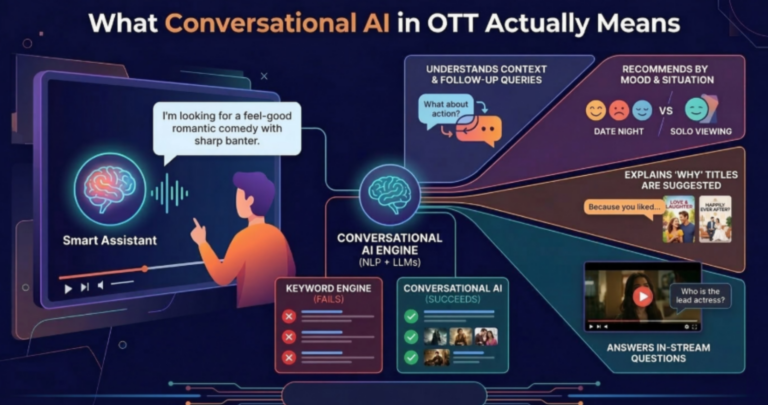
It’s not a smarter search bar. It’s a multi-layered intelligence system built on Natural Language Processing, Large Language Models, voice recognition, and recommendation engines, working together to understand not just what you typed, but what you meant.
Think of it as a smart assistant living inside your streaming app. It can:
When someone says, “I want something intense but not violent, with a strong female lead, in Hindi”, a keyword engine fails. A conversational AI succeeds.
Most users spend several frustrating minutes browsing before hitting play. Conversational AI collapses that gap and describes what you want, get results instantly. Roku’s adoption of AI-driven voice search saw a 40% increase in user engagement within just one year. Less browsing means more watching, and that’s a revenue outcome, not just a UX win.
Traditional engines know your history. Conversational AI knows your context:
“Something for family dinner tonight”
“A short film before bedtime”
“I have 45 minutes before my flight what should I watch?”
This shift from behavioral to contextual personalization is what makes a platform feel genuinely personal and builds the kind of loyalty that reduces churn.
In markets like India and Southeast Asia, multilingual audiences aren’t an edge case, they’re the mainstream. JioHotstar’s feature is specifically designed to work with multilingual queries, enabling users to search and browse in natural language across languages. Native language queries, Hinglish, Tanglish, voice instead of typing, the platform finally speaks the viewer’s language, not the other way around.
Conversational AI doesn’t stop at finding content. Imagine asking mid-stream:
“Who is this actor?”
“Show me other films by this director”
“What happened in the last over?”
Conversation AI can also be extended to live sports, where users can ask about player statistics, live scores, and key moments without leaving the viewing experience. OTT stops being a passive library. It becomes an intelligent companion.
The battle for viewer attention is no longer confined to the app. Leading platforms are already exploring integrations where users asking an AI assistant for entertainment recommendations receive contextual suggestions and direct streaming links, without ever opening the app itself.
Platforms that plug into where viewers already spend time, AI assistants, smart TVs, and messaging apps gain a structural discovery advantage that traditional in-app search simply cannot match.

Conversational AI isn’t just a UX upgrade. It moves the needle on every metric OTT platforms care about:
The global conversational AI market size was valued at USD 14.79 billion in 2025 and is projected to grow from USD 17.97 billion in 2026 to USD 82.46 billion by 2034 (source). Industry forecasts for 2026 point clearly to intent-based experiences as the defining competitive theme, and the center of gravity is moving away from content rows and toward conversations.
Platforms still optimizing their carousel layouts are solving yesterday’s problem.
At Logituit, we work with OTT platforms across the full product stack, from video infrastructure to AI-powered discovery. What we’re seeing is a clear inflection point: the platforms asking about conversational AI today aren’t just the early adopters. They’re mainstream players who’ve realized their competitors are already moving.
The good news: implementation doesn’t require a ground-up rebuild. Conversational AI integrates as an intelligent layer on top of existing infrastructure, your metadata, your behavior signals, your search systems. The quality of that metadata layer is what determines the quality of the experience. Platforms investing in rich, well-structured content metadata now are laying the foundation for powerful conversational AI tomorrow.
In 2026, OTT platforms won’t be judged by how much content they host, but by how effectively viewers find what matters to them.
The remote control gave viewers control. The recommendation engine gave platforms intelligence. Conversational AI gives both sides a language to meet in the middle.
For OTT product teams building the future of media, the question is no longer if conversational AI will arrive. It’s how fast you can make it meaningful for the viewer on their couch on a Friday evening, still unsure what to watch.

At Logituit, we specialize in building end-to-end OTT products and technologies, and conversational AI is the next frontier we’re actively working toward. Whether you’re a platform looking to add a voice-first discovery experience, a broadcaster exploring AI-powered search for your app, or a streaming service wanting to personalize at scale, we can build it, integrate it, and evolve it with you.
Our work spans video players, engagement features, content management, and AI-powered tools, all purpose-built for the media and entertainment industry.
If you’re ready to move from browsing to conversation, let’s talk. Write to us at:
marketing@logituit.com
Utkarsh Singhal
Utkarsh is a Product Manager with close to four years of experience managing B2C and B2B products. He specializes in mobile apps and web platforms, focusing on media and entertainment and Web3 products. Utkarsh’s expertise lies in leveraging technology to enhance user engagement and drive product innovation.
Beyond the tech world, Utkarsh is a coffee connoisseur with a refined palate for various brews and roasts. His passion for thrillers, mystery books, and movies fuels his analytical mindset, helping him unravel complex product challenges and craft engaging user experiences.
SHARE THIS ARTICLE
Stay up to date on latest trend in video tech
Related Posts
To provide the best experiences, logituit.com use technologies like cookies to store and/or access device information. Consenting to these technologies will allow us to process data such as browsing behaviour or unique IDs on this site. Not consenting or withdrawing consent, may adversely affect certain features and functions.