CASE STUDIES

Building an AI-Powered Pallet Verification Platform for Warehouse Operations

Case study_Oddness_Logituit
Customer

Oddness, a robotics and AI company transforming warehouse and logistics operations.

Background
Oddness develops AI-driven robotics solutions designed to automate material movement, inventory tracking, and warehouse operations. As part of its warehouse automation portfolio, the company was developing an AI-powered pallet verification solution capable of automatically validating pallet assembly using computer vision.


Problem Statement

Warehouse pallet verification traditionally requires manual inspection to ensure that the right products and quantities are loaded before shipment. This process is time-consuming, error-prone, and difficult to scale across large warehouse operations.

Oddness required a software platform that could operationalize its AI-driven pallet verification capabilities and support end-to-end review workflows.

Key challenges included:

  • Absence of an operational interface for warehouse personnel to review and validate pallet inspection results.
  • AI-generated verification results needed human-assisted review and exception handling workflows.
  • Warehouse operators required access to pallet images, discrepancy reports, and actionable insights in a single interface.
  • Multiple user roles, including administrators, online reviewers, and offline reviewers, needed role-based workflows and access controls.
  • Existing outputs were primarily raw files and image data, making it difficult for users to interpret and act upon inspection results.
  • The platform needed to support multiple warehouses and customers while maintaining scalability and operational efficiency.
Case study_Oddness_Logituit

Solutions

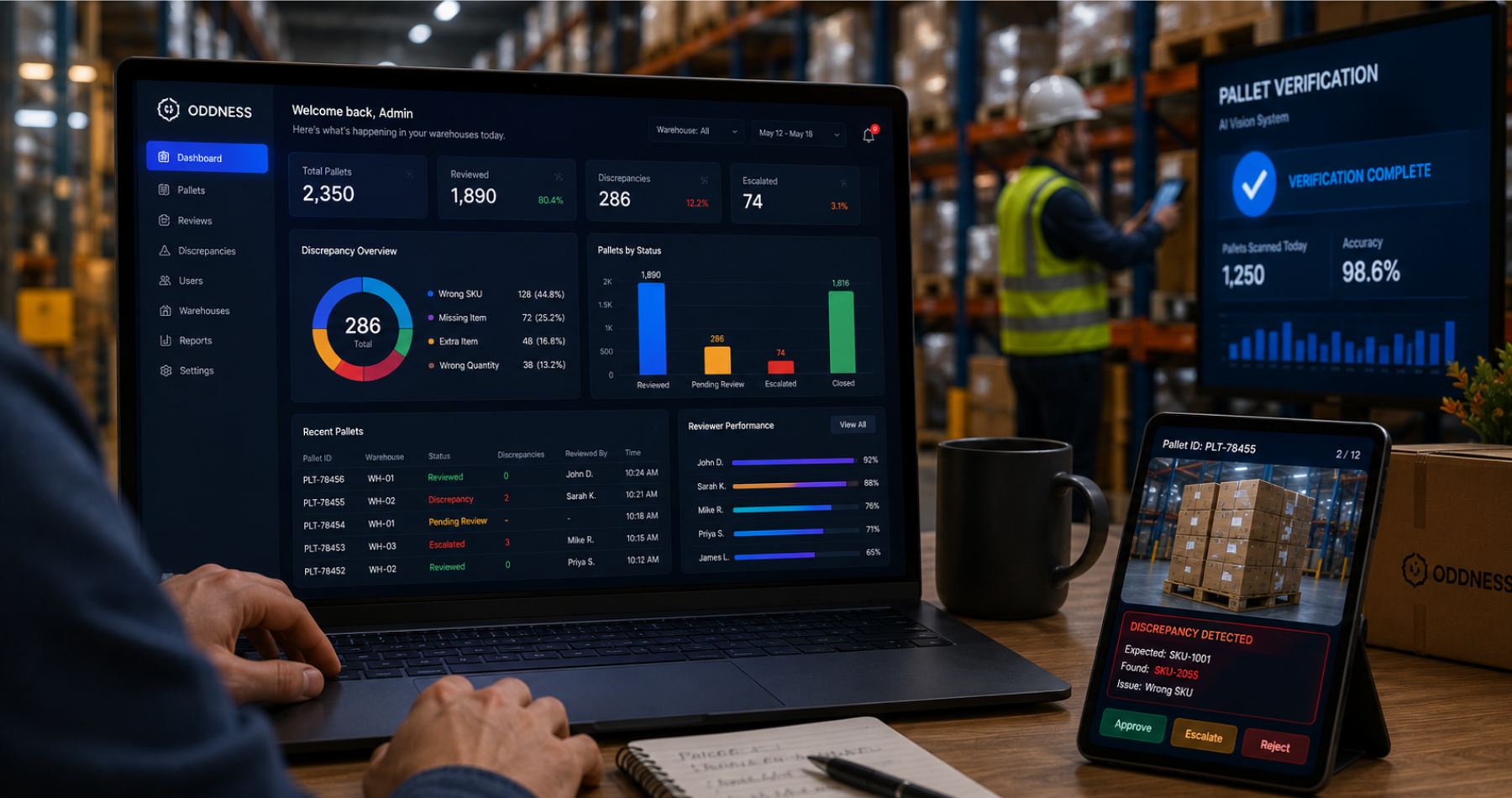
Logituit developed a comprehensive web-based pallet review and workflow management platform that bridged the gap between AI-powered vision systems and warehouse operations.

AI-Powered Pallet Review Platform

  • Built a responsive web application using React to enable warehouse users to review pallet inspection results.
  • Provided centralized access to pallet images, verification outcomes, and discrepancy information.
  • Enabled users to quickly review, validate, and take corrective actions on pallet exceptions.

Multi-Stage Review Workflow

  • Designed a role-based workflow supporting administrators, online reviewers, and offline reviewers.
  • Enabled online reviewers to validate AI-generated discrepancies and inspect pallet images.
  • Introduced escalation mechanisms allowing uncertain cases to be forwarded to offline reviewers for physical verification.
  • Captured final validation decisions directly within the platform, creating a complete audit trail.

Backend and Data Management

  • Developed a serverless backend architecture leveraging AWS Lambda functions for scalable processing.
  • Implemented DynamoDB as the primary datastore for storing pallet inspection results, images, workflow states, and operational data.
  • Automated ingestion and processing of pallet verification outputs generated by the vision system.

Operational Visibility and Performance Insights

  • Delivered actionable discrepancy reporting, enabling warehouse teams to identify incorrectly loaded SKUs.
  • Enabled tracking of individual picker performance and operational accuracy metrics.
  • Provided warehouse managers with visibility into worker performance, helping improve process quality and reduce recurring errors.

Multi-Tenant Platform Support

  • Designed the platform to support multiple warehouses and multiple customers from a single solution.
  • Established a scalable architecture capable of supporting future growth across warehouse networks.

Business Impact

The solution transformed AI-generated pallet inspection outputs into a fully operational warehouse workflow platform.

  • Enabled warehouse teams to review, validate, and act on pallet discrepancies through a unified interface.
  • Eliminated reliance on raw image files and manual interpretation, significantly improving operational efficiency.
  • Reduced manual verification effort by combining automated vision-based inspection with human-in-the-loop exception handling.
  • Improved shipment accuracy by identifying SKU mismatches before pallets were dispatched.
  • Provided performance metrics that helped warehouse workers identify mistakes and continuously improve operational quality.
  • Established a scalable software foundation that strengthened Oddness’ AI-powered warehouse automation offering and accelerated customer adoption.

SHARE THIS ARTICLE

Looking to build a similar solution?

Related Case studies

Step 1 of 2

Talk to an Expert

Step 1 of 2

Get in Touch

Fill out your inquiry and contact our team

Welcome cookies

To provide the best experiences, logituit.com use technologies like cookies to store and/or access device information. Consenting to these technologies will allow us to process data such as browsing behaviour or unique IDs on this site. Not consenting or withdrawing consent, may adversely affect certain features and functions.